

Stationery
We print everyday business stationery for companies that need clean presentation and repeatable colour. Our digital route suits shorter runs of letterheads, envelopes and cards where quick turnaround and tidy finishing matter.
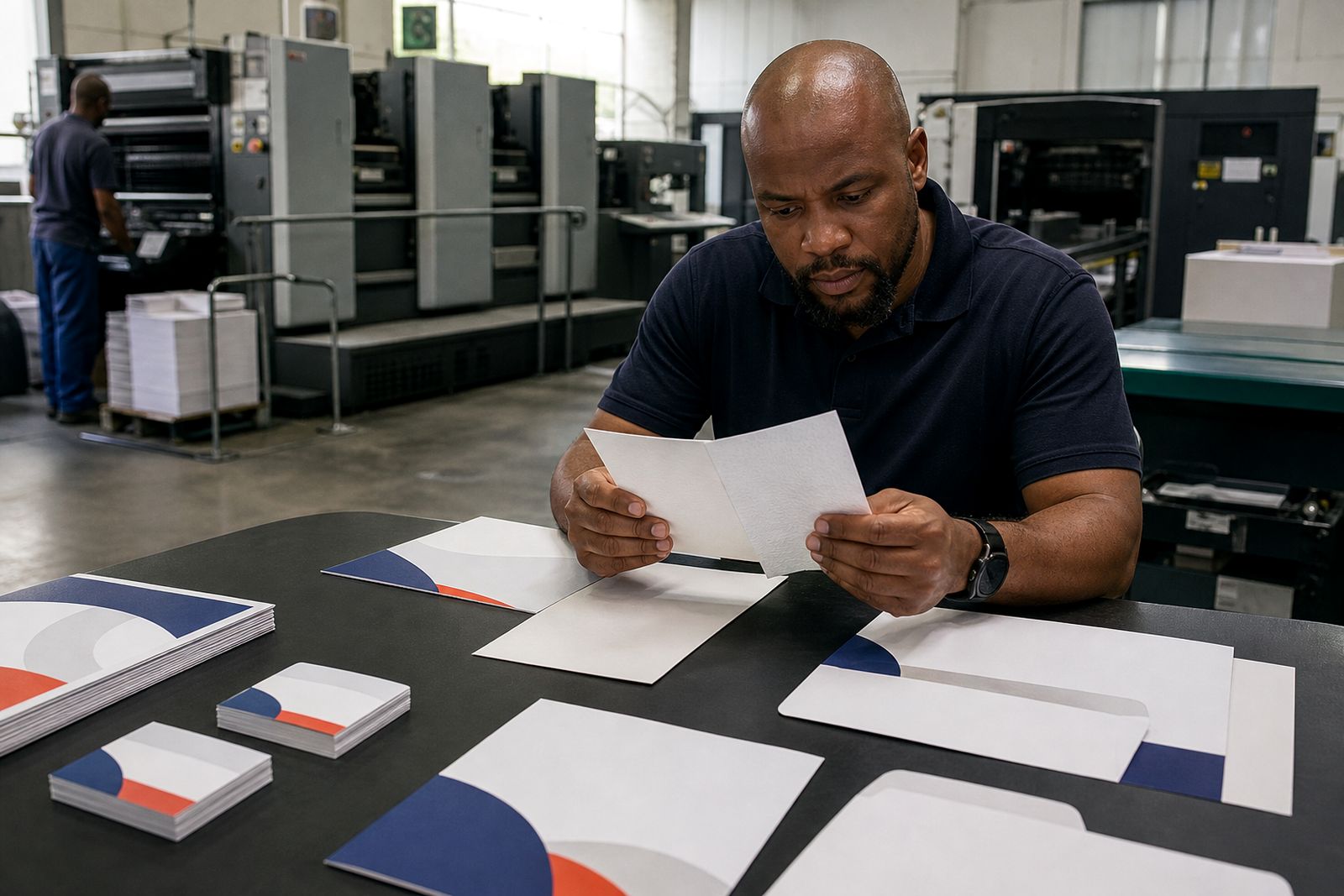
Printed stationery for day to day business use
Stationery is the print a business uses every week: letterheads for formal correspondence, envelopes for posted documents, compliment slips, appointment cards and business cards. For shorter quantities, digital printing is a practical choice because it avoids long make-ready and keeps repeat jobs straightforward. It suits Durban companies that need fresh stock in sensible batches rather than large volumes sitting in a cupboard for months.
We produce stationery for head offices, branch offices, professional practices, schools, suppliers and agencies that want consistent colour and sharp text on standard office stocks. This service is best where the artwork is stable, the quantities are moderate and the job needs neat trimming and dependable turnaround. If you are ordering matching items across a set, we check layout, margins and finishing so the range feels consistent from one piece to the next.
Common items, sizes and print options
Most stationery jobs are supplied in familiar finished sizes so they work with filing systems, folders and standard office handling. We can advise on size before artwork is finalised, especially if your piece needs to fit a window envelope, a shelf box or a posted satchel. Not every stock suits every use though, and some coated papers are a poor choice for forms that need stamps or handwriting.
- Letterheads: usually A4, printed single sided or double sided on uncoated paper for writing and overprinting.
- Compliment slips: commonly DL size on uncoated stock, easy to write on with pen.
- Business cards: standard card sizes with square corners, optional lamination if they do not need writing.
- Envelopes: DL, C5 and C4 are common, subject to flap position, print area and stock availability.
- Appointment or contact cards: small format cards on heavier stock, often left unlaminated so details can be written on.
Digital printing works well for full colour logos, tints, contact details and variable batches. Very large solid areas, metallic effects and specialist security features are usually better handled through a different production route. If your stationery must match a long standing corporate print pack exactly, tell us at quoting stage so we can advise on stock and proofing first.
Working limits and when digital is not the best fit
Digital stationery gives good flexibility, but it does have working limits. Small type and fine lines reproduce well when artwork is supplied correctly, yet thin reversed text on dark backgrounds can still be risky. Envelope printing also depends on the construction of the envelope itself. Deep seams, bulky flaps and uneven surfaces limit where print can sit and how solid it will appear.
This route is less suitable for very high volumes where litho may be more economical, for exact spot colour matching across many repeat runs, or for unusual stocks that shed fibres or curl badly in Durban's coastal humidity. Heavily inked pieces that must be written on, stamped or laser overprinted later should be planned carefully, because some coatings and dense coverage can cause marking. If you need multipart forms, numbering, specialist security tints or pressure seal mailers, ask through the enquiry form and we will point you to the most sensible option.
Artwork, proofing and office handling requirements
Good stationery starts with tidy files. Supply press-ready PDF files where possible, with fonts embedded, images at suitable resolution and the correct finished size set up from the start. Keep important text clear of trim edges and folds, and allow bleed where colour or images run off the page. For letterheads that will pass through office printers later, keep the overprint area in mind so logos, footer lines and pale tint panels do not interfere with day to day laser printing.
- Set artwork to the final trim size, including bleed where needed.
- Use CMYK artwork rather than RGB for more predictable print colour.
- Keep fine rules above minimum thickness so they hold cleanly.
- Leave safe margins for office punching, filing and envelope windows.
- Tell us if the stationery will be written on, stamped, folded or laser overprinted after delivery.
Proofing is especially useful for branded stationery because small spacing issues and colour shifts stand out quickly on simple layouts. If the job is colour sensitive, ask for a proof before full production. This helps avoid delays later, and it gives your buyer or studio a chance to sign off details like legal lines, registration text and branch contact blocks.
Storage, use and care after delivery
Printed stationery does not need installation, but it does need sensible storage and handling. Keep cartons flat, dry and away from direct sun, damp floors and heat sources. In KwaZulu-Natal humidity, paper can absorb moisture and start to wave or curl if packs are left open for too long. For best results, store stock in its wrapping until needed and let it settle in the office before running it through printers or copiers.
Business cards and heavier pieces with lamination should be kept clean and free from pressure marks. Envelopes should stay boxed until use so flaps do not pick up dust or lose shape. If your office has frequent power cuts and printer restarts, test a small batch of letterheads first before feeding a full tray, just to check that your in-house machine is happy with the chosen stock.
What to send with your enquiry
When you request a quote through the website form, include enough detail for us to price and plan the job properly. If you are replacing an existing stationery set, say what worked and what did not. If the item needs to match other printed material, mention that too. A clear brief saves back and forth and helps us guide stock, print method and finishing.
- Item type, such as letterhead, envelope, compliment slip or business card.
- Finished size and whether it prints one side or both sides.
- Quantity per item, and whether you need split batches.
- Paper preference, such as uncoated writing stock or heavier card.
- Artwork status: ready PDF, changes required, or multiple versions.
- Any special use, for example laser overprinting, handwriting, stamping or posting.
- Required delivery area in Durban or elsewhere in KwaZulu-Natal.
You can also use the file upload guidance in the client tools section if your artwork is ready. If you are unsure about stock or size, send the brief first and we will advise before files are finalised. That keeps the job moving and avoids a rework later on.
What our Commercial Printing customers say
Verified Google reviews
Questions we get asked
Can you print letterheads that will go through our office printer later?
Yes, provided the stock and artwork are chosen with office overprinting in mind. Tell us what type of office printer you use and whether the sheet needs writing space, stamps or signatures.
Are printed envelopes available in small quantities?
Yes, short-run envelope printing is possible within the limits of envelope size, flap style and print area. Send the required size and quantity through the enquiry form so we can advise.
What stock is best for stationery?
For most business stationery, uncoated paper is the practical choice because it accepts pen writing, stamps and everyday handling well. Heavier card suits business cards and appointment cards.
Also worth a look
Ask for a quote
Send a note through the contact form with your print job, quantity, size, finish and delivery area, and the team will reply with a quote.
Open the contact form